Food banks and other organizations that help feed those with limited resources do important work. However, food inequity is complex challenge that can’t be solved with reactive gap-filling alone. Hoping to support a deeper, problem-solving mindset, Integrated Project Management Company (IPM) tackled food injustice for its latest Project Mercy efforts.
“Food justice represents a move away from reactive charity toward proactive system design,” says Madison Danis, who led this quarter’s philanthropic program with fellow Boston-area consultant Nikki Lee. “Our goal was to support organizations that are re-engineering how nutritious, culturally relevant food reaches the communities that need it most.”
For example, food justice charities build physical infrastructure like urban farms to bring production closer to those who need it. Communities that control growing and distributing food can better meet their own needs, and they build long-term resilience and self-reliance.
Providing a Healthy Start
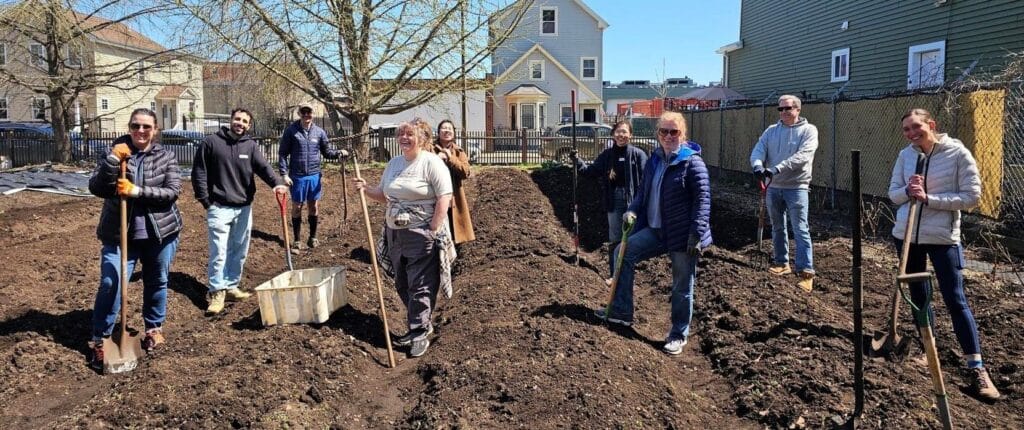
Danis and Lee led a team of volunteers from the Boston office in support of The Food Project. The nonprofit hires teens each summer to grow 100,000 pounds of fresh produce for local hunger relief organizations. IPMers learned about their mission to support food justice through urban agriculture and helped prepare two of its local gardens for planting.
Similarly, volunteers in Chicago helped prepare a community garden for the season. They weeded a walking path and space between the garden plots, then planted peppers, tomatoes, okra, squash, and other vegetables, which will help feed people in the community. The garden is a partner of NeighborSpace, a nonprofit urban land trust that supports about 125 community gardens by providing property ownership, insurance, utilities, education, tool lending, project planning, troubleshooting, and more.
Packaging and Distribution
Organizations that distribute locally grown produce also support food justice and equity. The Food Group, for example, sources food from wholesalers and local farms, then repacks and distributes it to its Fare for All affordable grocery stores and other food organizations in Minnesota. A team from IPM’s Minneapolis office volunteered at the nonprofit’s warehouse to sort food and pack boxes.
Likewise, IPMers in St. Louis broke down a bulk donation of potatoes into family-size portions for Operation Food Search, which distributes more than $32 million worth of food and necessities each year through more than 600 community partners. In San Francisco, volunteers sorted and packaged chicken, coffee, and fresh fruit for Second Harvest of Silicon Valley. And the Los Angeles office collected and sorted donations for Friends In Deed, which offers a food pantry among its neighbors-helping-neighbors programs.
Focusing specifically on helping the homebound to stay healthy and live independently, a group from the New Jersey office donated to the annual fundraising raffle of Meals on Wheels in Hunterdon. The team is also helping the nonprofit organization to secure a grant that would provide technology and assistance toward modernization.
IPM employees lead and participate in quarterly philanthropy efforts through our Integrated Project Mercy program. Visit our careers page to learn more about joining the IPM family.